
(And Why It’s Almost Never the Algorithm)
Scroll through any Amazon seller forum, and you’ll find the same postmortem, week after week: a brand launches strong, rides a few weeks of decent sales, and then quietly flatlines. The seller blames the algorithm. The agency blames ad spend. Nobody asks the question that actually matters: what happened between week two and week twelve that nobody was watching closely enough to catch?
That gap — not a mysterious COSMO update, not bad luck — is where most Amazon brand launches actually die.
In our experience, the brands that succeed aren’t necessarily those with the biggest budgets. They’re the ones that treat launch as the beginning of a long-term growth strategy, not the finish line.
Quick Answer
Amazon gives every new listing a short visibility boost — roughly the first two to four weeks — to test how buyers respond. Launches that don’t convert well during that window lose the boost and settle into a low organic rank, which is very hard to recover from without a deliberate relaunch. Most “stalled” launches aren’t algorithm failures. They’re a missed honeymoon window, usually caused by a listing, review base, or execution team that wasn’t ready to capitalize on the traffic when it mattered most.
The Mechanism Everyone Half-Understands
Amazon’s algorithm doesn’t reward the best product. It rewards the product with the best rate of sales, reviews, and conversion relative to its category — measured in a narrow early window, not over the life of the listing.
New ASINs get a temporary visibility lift while Amazon collects data on how shoppers respond. If the listing converts well during that stretch, Amazon reads it as a signal worth ranking. If it doesn’t, the boost gets pulled, and the listing settles into whatever organic position its early performance earned it, which, for a launch that wasn’t ready, is usually page three or worse.
This is why launches that “looked fine” on paper still stall. A brand can have a clean listing, a modest ad budget, and zero policy issues, and still lose the only window that mattered because nobody was actively managing it in real time.
Seven Reasons Behind Almost Every Stalled Launch
- Reviews never reached a trust threshold — A listing with zero to five reviews converts at a fraction of one with fifteen to twenty, and that early conversion rate gets baked into the baseline Amazon judges it on.
- The listing converts below category average — Traffic arrives, but the page doesn’t close, so the ranking signal decays even while ad spend continues.
- Ad spend stops before organic rank is established — Sellers pull back the moment CPCs feel expensive, right when Amazon is still deciding whether the product deserves rank.
- Indexation gaps — The backend search terms and title were never actually built around the keywords the brand intended to rank for, so the traffic never shows up in the first place.
- Inventory Planning Becomes Reactive — As sales patterns change, many brands face stockouts, excess inventory, higher storage fees, and lost Buy Box opportunities that disrupt growth.
- Competitors Finally Respond — Once your product gains traction, competitors adjust pricing, promotions, PPC bids, and listings. Without ongoing optimization, it’s easy to lose your advantage.
- Optimization Slows Down — Many brands treat launch as the finish line, reducing listing updates, keyword research, creative testing, and PPC optimization while competitors continue improving.
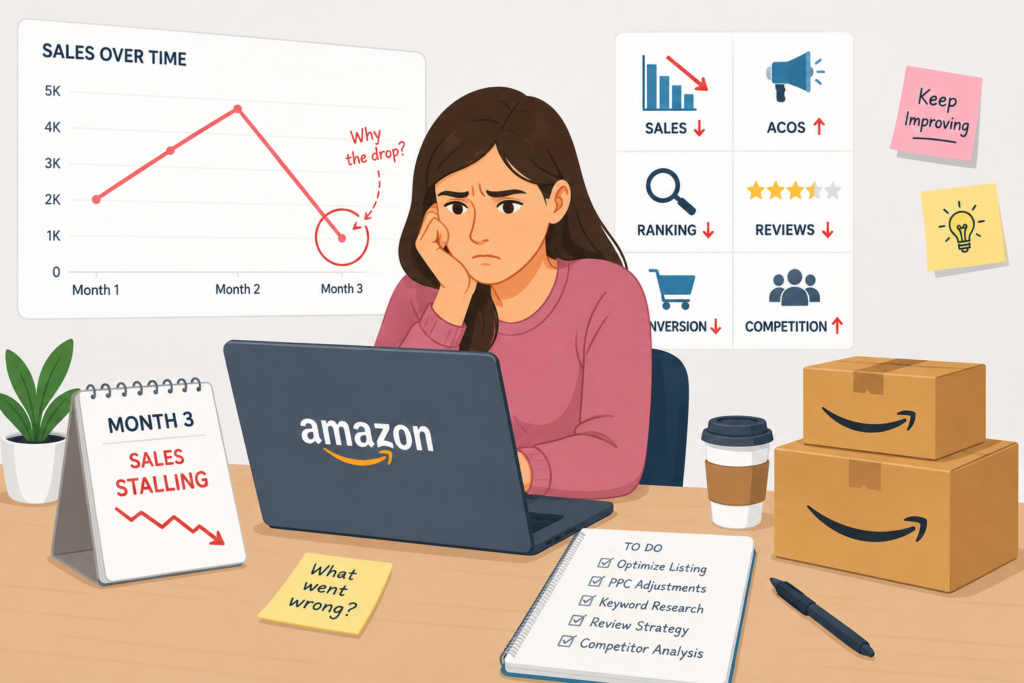
Individually, each of these is fixable. Together, unmanaged, they compound — and by month three, what looked like a promising launch reads to Amazon as a slow mover. That label is expensive to shake.
What a Stall Actually Looks Like, Week by Week
The pattern below is a composite of common launch trajectories, not a single client’s data — but it’s a fair representation of how a stall unfolds versus how a managed launch holds.
Weeks 1-2: Identical Starts
Both listings go live with clean titles, decent images, and a small ad budget. Amazon extends the honeymoon boost to both. Sessions climb. On the surface, nothing distinguishes one from the other yet.
Weeks 3-4: The Fork
The stalled listing keeps running the same automatic campaign untouched; reviews sit in single digits, and conversion rate quietly drifts below category average. Nobody adjusts anything because nothing looks obviously broken. The managed listing gets checked daily: search terms get tightened around what’s converting, Vine units start landing reviews, and a short coupon lifts click-through at the exact moment Amazon is still deciding whether to keep boosting it.
Weeks 5-8: She Signal Locks In
Amazon reads the stalled listing’s flat-to-declining conversion as buyer disinterest and quietly withdraws the visibility boost. Organic rank settles on page three or worse. Ad spend on the managed listing is now converting at close to organic rates, because reviews and conversion rate cleared the trust threshold while the boost was still active — so Amazon keeps ranking it.
Month 3: Two Different Businesses
The stalled brand is still running ads just to stay visible, with rising ACOS and no organic momentum to fall back on. The managed brand’s organic rank is now doing a meaningful share of the selling on its own, and ad spend is funding growth rather than propping up a listing that never earned its rank.
Nothing separated these two launches at week one. What separated them was whether anyone was close enough to the account to catch the fork in week three, before it became a month-three outcome.
What Successful Amazon Brands Do Differently
The strongest brands understand that launch is just the first chapter.
Here’s what they focus on after going live.
Before Launch
- Build listings around customer intent.
- Validate keyword opportunities.
- Create a realistic inventory forecast.
- Prepare a post-launch optimization plan.
Days 1–30
- Monitor indexing.
- Track conversion rates.
- Optimize advertising frequently.
- Collect customer feedback.
- Improve listings based on performance.
Days 30–60
- Expand keyword targeting.
- Refresh creative assets where needed.
- Analyze profitability—not just revenue.
- Identify winning search terms.
Days 60–90
- Refine PPC structure.
- Improve organic ranking strategy.
- Review inventory forecasts.
- Test pricing and promotional tactics.
- Double down on high-performing campaigns.
Beyond Month 3
The goal shifts from launching to scaling.
Successful brands continue investing in:
- Listing optimization.
- Catalog expansion.
- Conversion rate improvements.
- Profitability analysis.
- Competitive monitoring.
Growth becomes a continuous process.
The Real Reason Most Launches Stall (And Why It’s Not the Algorithm)
Here’s the contrarian part: the seven patterns above aren’t really seven separate problems. These are seven symptoms of the same root cause; nobody was watching closely enough, quickly enough, during the only window that mattered.
That’s an attention problem, not a strategy problem. And attention is exactly what gets rationed when an agency is running the same 90-day sprint across forty accounts at once. Review velocity, conversion rate, and organic rank all need to be checked and adjusted daily during the honeymoon window — not reviewed in a weekly report after the damage is already done.
This is the uncomfortable truth most “launch strategy” content skips: the tactics are not the differentiator anymore. Vine enrollment, exact-match PPC, and A+ Content are standard practices now — every competent agency runs them. The differentiator is whether a human being is actually watching your specific listing closely enough, early enough, to catch a stall before it becomes permanent.
What Actually Prevents the Stall
Treat the first 30 days as a sprint, not a checklist
Creative, reviews, and ad spend need to move together in a single coordinated window, not as separate to-dos that different people touch on different schedules.
Diagnose before you spend more
A stalled listing usually isn’t an ad problem. Pull sessions and conversion rate before increasing budget, throwing more spend at a listing that can’t convert just burns cash faster.
Confirm indexation before blaming the algorithm
Search your own ASIN against your target keywords from a logged-out browser. If it doesn’t appear, no amount of ad spend or patience fixes that — the backend terms need attention first.
Match team bandwidth to launch complexity
A launch getting checked once a week is not being managed during its only real window of leverage. This is the specific reason best Amazon management agencies built around a small, fixed roster of brands tend to outperform larger shops on launch outcomes, not better tactics, just more attention per account, when attention actually matters.
Warning Signs Your Launch Is Losing Momentum
If you notice several of these indicators, it’s worth investigating before performance declines further.
- PPC is responsible for nearly every sale.
- Organic rankings haven’t improved for weeks.
- Advertising costs continue increasing.
- Conversion rates are falling.
- Inventory forecasting feels unpredictable.
- Competitors consistently outrank your listings.
- Profit margins continue shrinking despite steady sales.
One or two warning signs may be manageable. Several together usually indicate deeper strategic issues.
Launching Is Easy. Sustaining Growth Is Hard.
Amazon rewards brands that continuously improve.
The companies that keep winning aren’t always those with the biggest budgets or the most products. They’re the ones that consistently optimize their listings, refine their advertising strategy, monitor profitability, and adapt as the marketplace changes.
That’s why Amazon launch failures often have less to do with the launch itself and more to do with what happens afterward.
If your brand has already launched but growth has slowed, the answer usually isn’t to spend more on ads. It’s to identify where momentum has been lost and rebuild the strategy around sustainable, long-term performance.
At Meliora Marketing, that’s exactly where our help brands make the shift—from chasing launch-day wins to building Amazon businesses that continue growing well beyond Month 3.